
It’s for Protection
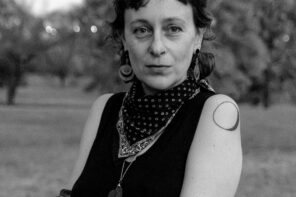
Alexander Martin (she/her) is a Black and trans artist and performer working out of Peoria, Illinois. Her practice includes visual art, performance, drag, advocacy, education, and community engagement. Her work centers on celebrating, documenting, and highlighting the intersections of her identity. She has had her work exhibited across the states and has done artist residencies in both the US and UK. She is a former state title holder for the drag pageantry system Miss Gay Illinois USofA and has performed all across the US. In 2022, she was featured in the PBS Short Film Festival for her collaborative documentary, The Daily Aesthetics of Alexander Martin, with filmmaker Allison Walsh. She is a founding and former board member of the Peoria Guild of Black Artists, a co-founder of Project 1612, and involved in several community-based efforts. She is an Assistant Professor of Art and Gallery Director at Eureka College.
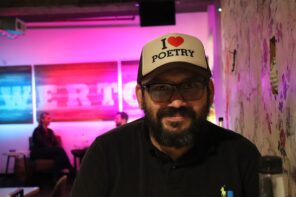
The winner of an Academy of American Poets University Prize, Gabriel Ridout is a mixed Filipinx-American poet-scholar, currently a PhD student in English at WashU. Poems are featured or forthcoming on poets.org, in Hoxie Gorge Review, in Nightboat Books’s Permanent Record anthology, and elsewhere.
Gabriel Ridout: I’m just curious where a painting starts for you. How does the idea form? And then, because I know you work in multiple modes: how do you decide, this is a painting, or this is a sculpture, or this is a piece of writing?
Alexander Martin: It’s interesting, because in the past five years—coincidentally since transitioning—my methods have changed a lot. In my early work toward the end of graduate school, I was doing a lot of sculpture and exploring the confines of masculinity, which should have been a big indicator of what was coming in my future. [laughs] I was like, “All this work’s about masculinity, how it’s a prison and we should break free from it.” That should have been a clue. [laughs] I was trained in printmaking, and I only started painting due to a lack of print material, a lack of resources, not wanting to build a lab. But I started understanding and manipulating that medium more. Now my process has actually shifted to what it was when I was a kid. I used to draw powerful women—these really powerful women—in dresses, and they represented the elements. Another indicator of what was to come. [laughs] I was making superheroes and fan art when I was six years old. Now I feel like I’m doing that again.
GR: Play is so important. Not just in art, but in life.
AM: Yeah. One of my more playful paintings, It’s For Protection, started with, “I really want to do a picture in a bonnet. I love my bonnets; they’re for protection.” But then I also wanted to bring in the evil eye, a charm for protection, and I had recently finished a game, South of Midnight, which uses Creole and Southern folklore, Black historical folklore. I learned about “haints,” which are like evil spirits. People in the South used to paint their [porch ceilings] haint blue to protect from spirits. So all of these things—my video games, my bonnets, my fashion—tie together.
GR: Of course, I want to talk about your fashion, because I remember when I met you at a conference a few years ago, you were wearing a pair of spotted cowhide boots, I think. And your jewelry—that made an impression on me. Your passion for fashion, I can feel it in the work. I wonder if you can speak to the way that you’re thinking about clothing and self-making through the sartorial in your artistic practice.
AM: When I was in grad school—this was 2016, I think—I had a critique with Michiko Itatani. She was a professor at SAIC [School of the Art Institute of Chicago]. She was looking at my work, and she said, “I see you and I see all this color and shape, and your work doesn’t really have that. Your work’s very smart, but where are you in it?” And that stuck with me. It was because I was afraid of the parts of myself that I was only just starting to present outwardly. The clothing I wore, the ways in which I expressed myself—I still didn’t view that as serious. I was falling into that academic mindset of, “Oh, that’s for fun, that’s not professional.” I was letting professionalism taint my work. Statistically, I should not be in academia. Being a professor, making a living from what I do, is very rare for people of my demographic. Being from West Virginia [and] growing up poor, when I got to college, it felt like I somehow had to fake it to make it, which is a lie. I tried to undo that mindset, especially after Michiko’s critique. How I dress, how I express myself daily, is a part of my practice. Everything is art. It’s how you live, how you see the world. So I’m thinking when I dress myself: who am I today? What am I embodying today? [And] because I started being more honest in my practice and having fun again, my paintings started to reflect how I dress. Even lounging around the house, I think of what I’m lounging in: this outfit is for comfort, for myself, not for anyone else. Maybe my muumuu and bonnet combo is what I’m feeling in that moment. But for various reasons—professionalism or whatever—we sometimes don’t tap into that daily dose of making.
GR: I think it’s important to feel the fantasy and to honor the everyday ways that we produce culture and theorize. Maybe that’s just my way for me to absolve myself of guilt, watching The Real Housewives of Salt Lake City when I should be doing something else, something productive. I tell myself that this is theory: I’m theorizing. And I’m being facetious, but there’s some truth there.
AM: If you look at the ballroom and housewife realness—or business casual realness? —what this idea of realness gets at is, we don’t have access to these jobs, these positions. But we’re going to wear them so convincingly that people in those positions will want to dress like us. We’re going to set the culture for a world that has excluded us. And that bit of fantasy, that bit of delusion as fuel, has led to the creation of so much culture. I feel it’s my right to plug in and use it. We all should.
GR: That’s good—delusion as fuel. You brought up self-portraiture and It’s For Protection. I love that the painting is an invitation to feel joy, and it’s so accomplished in its use of materials. Can you speak a bit to the thought process behind the material, the fabric of it all, the nails?
AM: I was just posing in the mirror and laughing, and I took a few photos. I do performance art, and I also do drag, so there’s a lot of late nights, coming home, putting away costumes, washing your face off. There’s that moment after a show where you’re not quite ready to give up the illusion yet. You’re not quite ready to give up the fantasy. And at a certain point, you think, “I never have to give up the fantasy. It’s not a fantasy—this is my reality.” There’s this moment in between where the veil is thin between the stage and your own reality. For me, a bonnet with a full beat is a fantasy. I love bonnets. We police them for being unprofessional, especially in the Black community. We had #bonnetgate years ago on the internet, where some people were saying, “We’re not performing for white standards. If we glorify the messy bun, why can’t we glorify a bonnet? This is our messy bun.” So I took the photo and used Procreate—that’s the app that some of my digital paintings and collages are made with—to edit the photo and up the saturation a bit, because I want my paintings to have an element of neon or a glow, like queer nightlife.
GR: The dimensionality of the work, what you’re saying about nightlife and neon-ness of the paintings, there’s a lit-from-within quality that’s so compelling and, honestly, moving.
AM: As a kid, I always thought the big city was just clubs and dancing. I was watching The Wiz recently, and that moment when they get to the Emerald City and the lights change colors and their outfits change—that’s what I thought nightlife was. That fantasy I had as a kid, I put in the work when I play with color. Material-wise, I just hoard things. I get my nails done and I go wild, asking, “What can I not do with my nails in reality?” And I’ll put that in the painting, make them sapphires. Or with digital collage, I can create with impossible materials, like moving water or magma.
GR: There’s something elemental about your latest work.
AM: I want what I make to feel like it comes from somewhere—from me, obviously, but also from a place people want to be. [Ever] since I was a kid, imagining worlds was my escape. I’d watch cartoons, play games, and imagine, what if I had powers? That’s why I’m building a pantheon, a mythos, a whole arc of Black, queer, [and] trans history, legacy, and oral tradition. I don’t make it too specific, but the world I’ve created has rules, principles, a language, gods, and houses. Many of my figures are members of divine houses, based on ballroom culture but named after celestial bodies. For example, Mars, the House of Mars, is the house of transfemininity, where it’s a gift to exist in a transfeminine body. It’s not something I’m stuck in; it’s my temple. To be trans on this planet, it sometimes feels alien. But in my paintings, I imagine a mystical realm where we’re valued because what we represent is divine and sacred. This is my way of using a fantasy lens to navigate real feelings, real-life burdens. Imagination makes confronting and sharing those burdens feel cathartic.

GR: Each painting feels recuperative, in a way. I’m looking at Release, The Sacred Act of Catharsis now, and I adore this painting—the dunes in the background, the jewelry, the piercings, the nipple ring, and the tears. The figure here is like an avatar, I think, but you allow him to feel.
AM: The recent work is mostly in this direction, allowing release and feeling. Making this piece, I thought I could cry. It felt good. Seeing different kinds of emotions, that’s important to me. Who is allowed to feel what? This figure could be considered a conventionally masculine presence, but he sheds tears. Because of norms and just surviving the world, I think we’re pressured to deny ourselves. But we need to see people cry, because we all cry sometimes.
GR: It’s a rare thing to see.
AM: It’s essential to see different kinds of bodies, too. This is why so many of my figures are often Black, plus-size, transfeminine—like my body. The fatphobia that permeates our world is rooted in racism, is rooted in fascism, is rooted in this idea that there’s only one correct body type. Especially today, it’s like diet culture is back, but worse.
GR: You’re spot-on that fatphobia and fascism are at work in our politics, culture, and fashion. We see it in quiet luxury and tradwife aesthetics, these dominant trends that make your work feel even more radical and necessary. Your paintings are so imaginative and infused with culture; you mentioned you’ve been influenced by video games, superheroes, Afrofuturism, and The Wiz. You and I have spoken about Devan Shimoyama and his creative use of color and unconventional materials, like sequins and glitter, in his portraits. Who else do you see yourself in conversation with?
AM: Devan Shimoyama’s a huge influence. Tariku Shiferaw, a Black abstract artist—I thought about his work a lot when I was teaching art history, because people expect figurative work from Black artists, but what are Black aesthetics beyond that? What is Black abstraction? I also really like April Bey, who does Afrofuturistic, mixed-media textile art. Nick Cave—the way he clusters things together, I love that. His work in costuming—[and] even his 2D work—feels encrusted and built up. It feels Black, it feels queer. I’m working right now with a box of old jewelry and a bunch of things I’ve painted gold, and I’m going to start attaching them, barnacle-style, to things. And yes, in The Wiz there’s Evillene, the Wicked Witch of the West, who is Black villainy. I love her. She wears a big suit covered in fabric and jewels, almost like something Nick Cave would make. In my drag shows, I perform the song Evillene sings. So yeah, those are some of the artists I look to and the voices I listen to.
GR: I love how you describe the texture and touchability of art—even art that’s not supposed to be touched. I’m reminded of a scene in Paris Is Burning where Venus Xtravaganza says, “Touch this skin, darling . . . Touch all of this skin . . . You just can’t take it.” Very iconic. I see that same confidence and audacity in your paintings.
AM: A lot of vocal stims in Paris Is Burning. Those are my people.
GR: For you to be channeling these Black, queer, and trans legacies, it’s really powerful. And I know that you’re teaching and you’re involved in community care work. How do your pedagogy and activism feed your artistic practice?
AM: I always say that art is a way you live. For me, teaching is part of it. I took a break post-pandemic from academia because I was adjuncting, doing the grind a lot of us are familiar with. Then my sister passed away in 2019, right before the pandemic hit, and the shock of losing someone I grew up with pulled me out of my body for a minute. I felt like I shouldn’t be doing anything that wasn’t serving me or serving the people I care about. I quit everything and worked in public health, in HIV prevention and care. A lot of people in the community, a lot of Black trans women I know, start there professionally because it’s one of the only industries that will hire us. I worked in case management, getting folks medication and testing, trying to tap into the ancestral caretaking our community has always done. So I wasn’t teaching at a university, but I was teaching my community things that affect us directly. I didn’t know if I would come back to academia, but I did in 2022, and the years off really influenced my teaching: now I take a healing approach. In 2024, I started a full-time, tenure-track position at Eureka College. That journey took a lot of work, and my path was roundabout, but I didn’t do it alone. We don’t have to live that way. And education doesn’t just happen in a classroom or lecture hall. My community, living my life—that was where I learned what matters.
GR: I want to end with a question that my mentor, the poet John Murillo, asks his students, and that I’ve started asking mine: what brings you joy these days? Or: what are you living for?
AM: There’s a witch store in our mall that has a huge wall of dried herbs. Recently, especially in this cold, I’ve been making large pots of mixed herbal tea almost daily. My partner and I will watch something on television in the evening and have a cup of tea to relax. It’s usually paired with an evening walk. That little routine has given me a will to live. If I want to make good work, I need a daily walk and a really good cup of chamomile. The quiet moment at home, the feeling of being warm, has been bringing me joy. It’s been very regulating during a time when regulation feels like an impossibility.
GR: Thank you for that, Ms. Alexander Martin. Thanks again for this conversation, and for everything you do.
AM: Thank you so much, Gabriel.
The six paintings Ms. Martin contributed to Issue No. 17 of The Spectacle can be viewed here.
More of Ms. Martin’s work can be viewed at msalexandermartin.com. Her Instagram is @ms_alexander_martin.